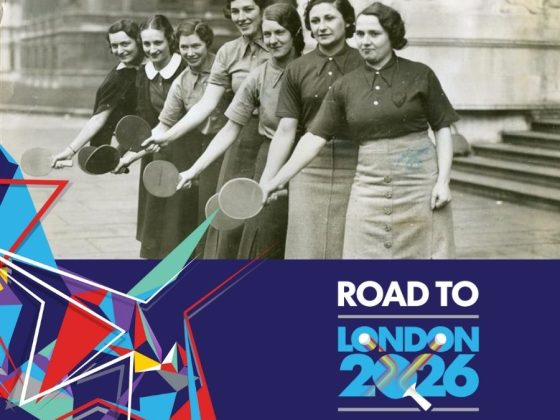
In the latest instalment of our series on England’s World Championships performances over the years, Diane Webb (Chair of Archives, Museum and Records Committee) looks at 1935, when once again London hosted the Championships. With thanks to Gunther Angenendt, Mike Rhodes and Graham Trimming for photos.
Keep an eye on our website and social media platforms for a host of features in our Road to London 2026 series – and click below to secure your tickets for London 2026.
In 1935 the World Championships returned to London on a much bigger stage than in 1926. Matches were played at the Imperial Institute in Kensington with the finals at the Empire Pool & Sports Arena, Wembley.
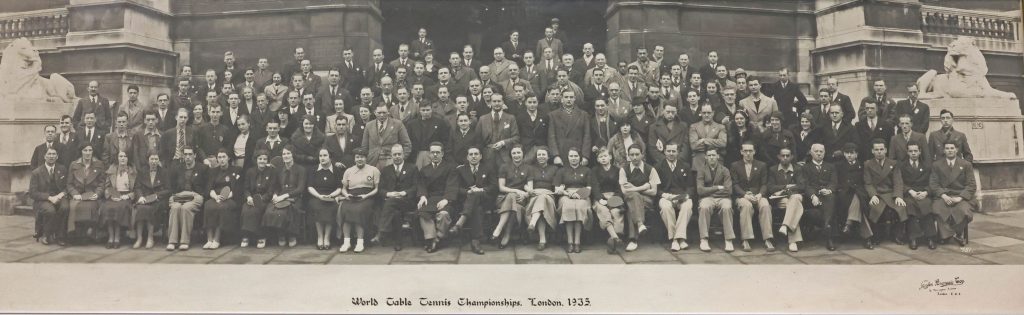
Players and officials got together for a group photo which is now held at Table Tennis England’s offices.
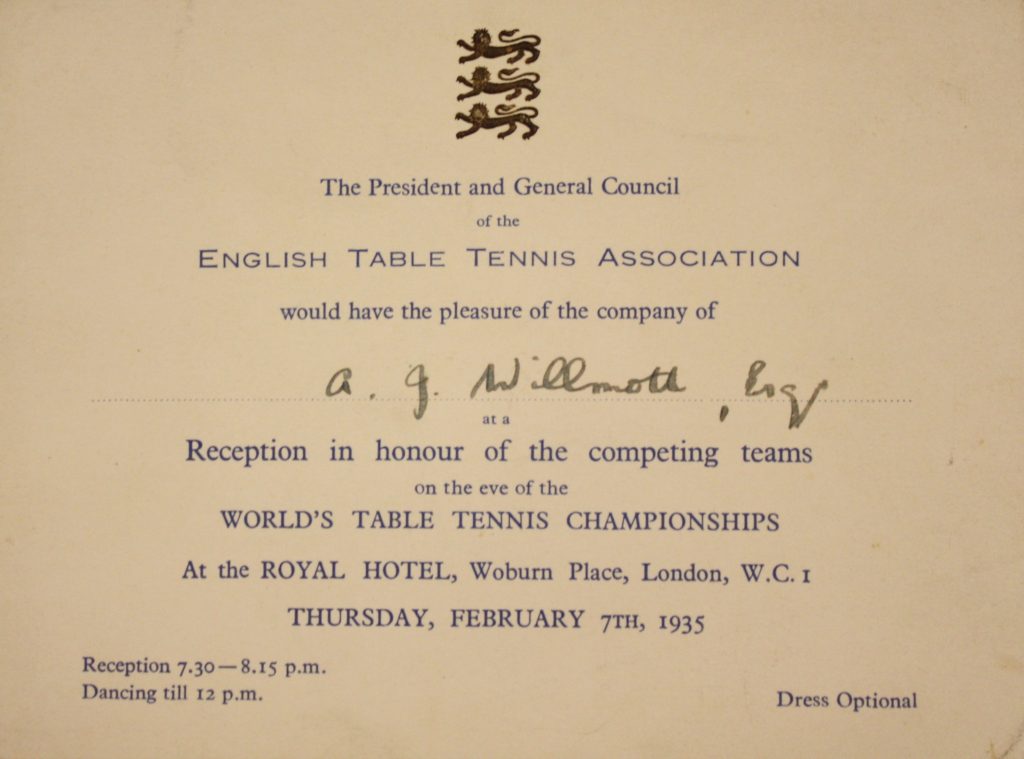
On the eve of the Championships, a reception and dance were held at the Royal Hotel, which was a great success, and to add to the prestige of the Championships the draw was performed at the Savoy Hotel by the Marquis Pallavicini, The First Secretary of the Hungarian Minister.
The other non-playing aspect of the Championships was the ITTF Congress and here there was a significant change to the rules. Up until this point there had been a distinction between amateur and professional players. At Congress it was agreed to delete all references to the terms ‘amateur’ and ‘professional’ and replace with ‘player’. This had an impact on entry into the Olympic Games and table tennis didn’t become an Olympic sport until 1988.
There was discussion about how to deal with too much defensive play by the ‘stone-waller’ as there were some exceedingly lengthy matches. Lowering the net to 6” was discussed as a possible option to encourage more attacking play.
One rule which was still in force was that the ball “shall be delivered by the server projecting or dropping the ball by hand only, without deliberate deformation of the surface, into the air”. Finger spin was allowed but “it may not be imparted by holding the ball and rubbing the racket surface against it before it leaves the hand”. No artificial aid could be worn on the fingers such as a rubber finger-or-thumb-stall.
The major task of referee was on the shoulders of J Morris (Maurice) Rose. That title little reflected the enormous task he had undertaken not only during the Championships where he said, “ten days of the actual Championships . . . or rather 10 days and nights, since during that time we hardly slept” but over the preceding 12 months, including sourcing the venues.
The ETTA Chairman, Corti Woodcock, rightly praised him and said the Association was profoundly in his debt. Rose went on to referee in 1938 and 1948 and was invited to referee in Cairo in 1939.
Bill Pope, the Organising Secretary, was another who worked tirelessly at a myriad of jobs. Another stalwart was John Siddron, Tournament Secretary and ETTA General Secretary, who took the entries, the numbers of which had increased considerably. The fees were 6/- for singles and 12/- for each doubles pair.
An army of volunteers spent innumerable hours to help make the ninth World Championships such a success. The Press came in for praise too, as they “gave us veritable slabs of space right and left; anything we wanted published – in it went”. Many of the prominent officials and volunteers were presented with medals as a sign of appreciation.
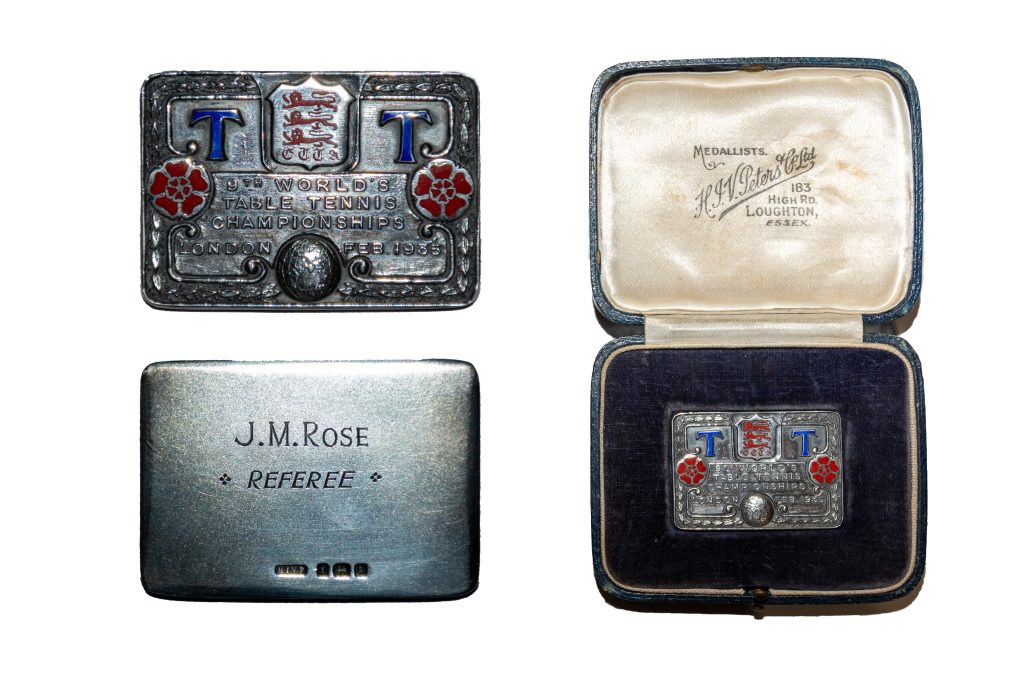
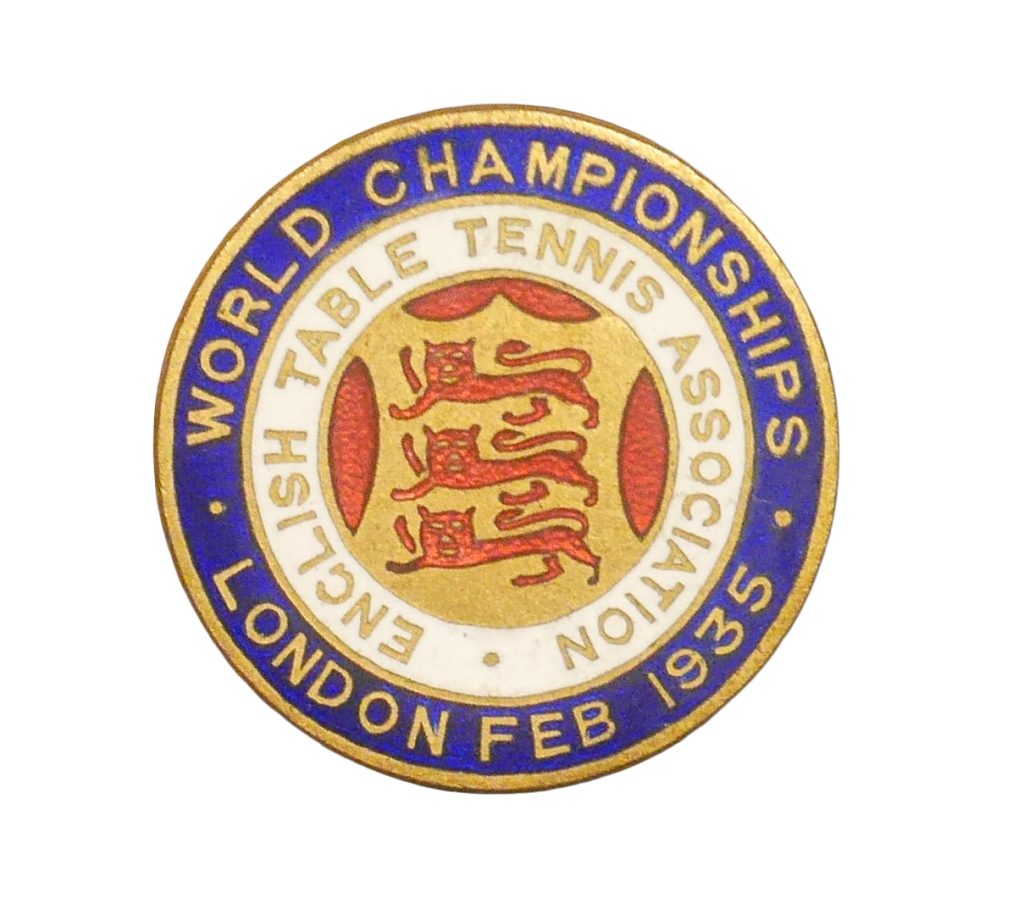
Right: A pin badge
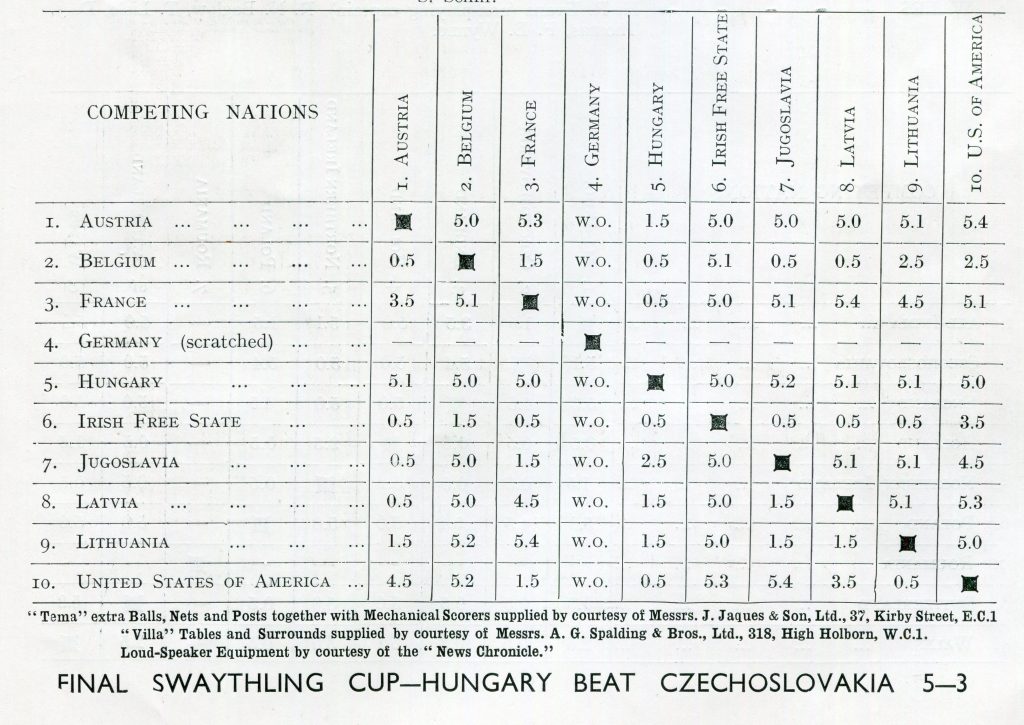
For the first time, the Swaythling Cup was split into two groups – a requirement, as over 14 teams had entered. There were 19 teams originally, but this number was reduced to 17 as Germany withdrew and Romania did not appear. The winner of each group would then meet to decide the title. North America was now represented as the USA sent two teams to England.
Maurice Bergl was a new name in England’s Swaythling Cup team and he played with established players – Herbert Hales, Adrian Haydon, David Jones and Andy Millar. Ivor Montagu was back as team captain and captained both the Swaythling Cup and Corbillon Cup teams.
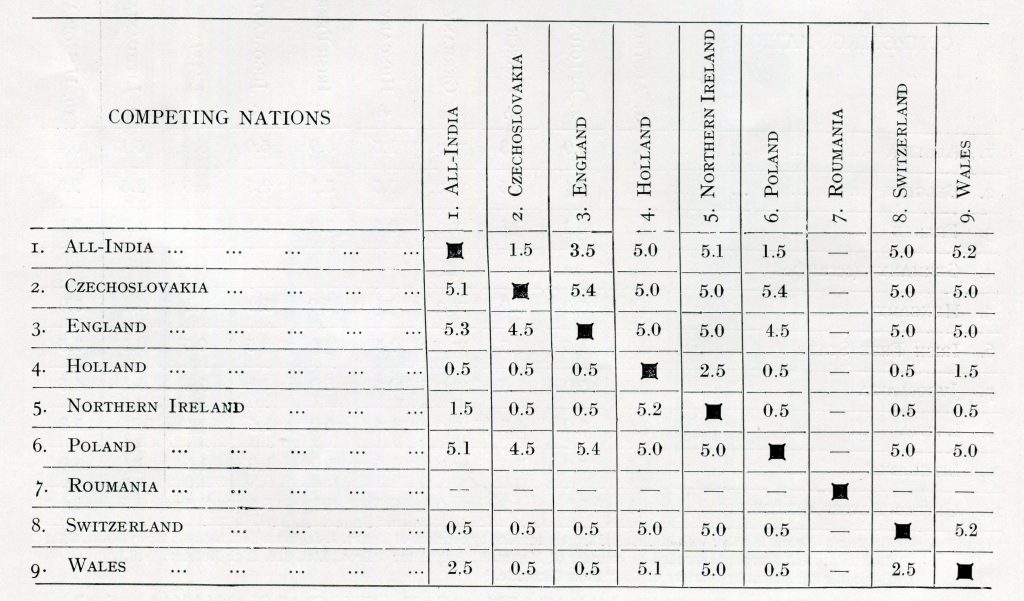
England’s opponents were Czechoslovakia, All India, Northern Ireland, Holland, Poland, Switzerland and Wales. They had 5-0 wins against Northern Ireland, Holland, Switzerland and Wales and a 5-3 win against All India. Their losses were to Czechoslovakia and Poland, both 4-5. Czechoslovakia finished top of this group and Hungary top of Group 1, both teams not losing a match. The final was a win for Hungary 5-3. Poland and Austria were joint second and England finished in fifth place.
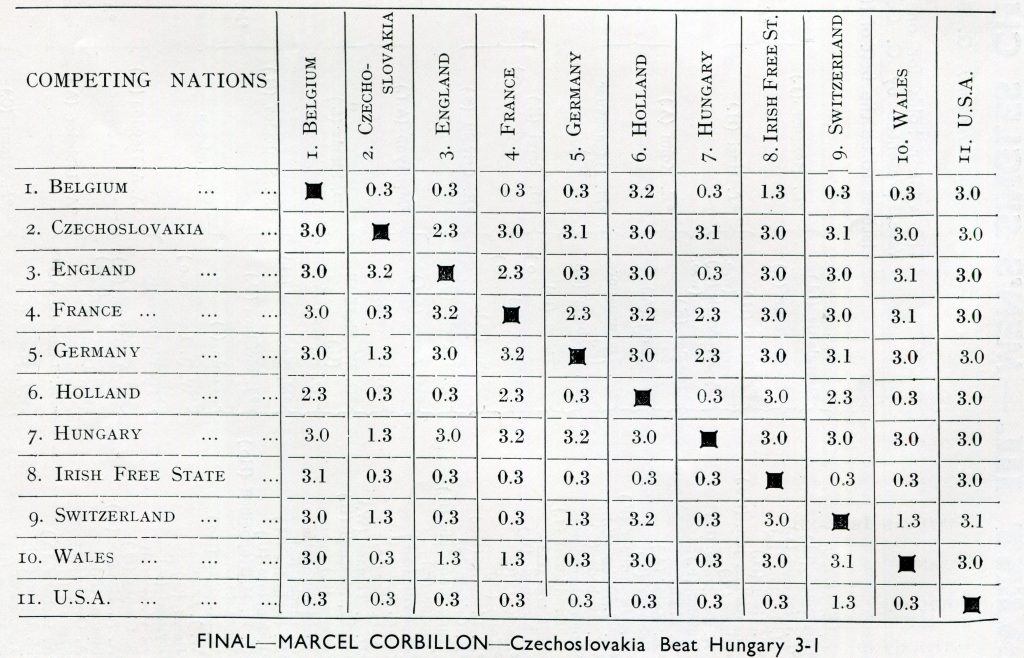
Eleven women’s teams took part in the Corbillon Cup, nearly doubling the number from the last Championships. A heavy schedule of 10 matches for the players. Dora Emdin, Margaret Osborne and Wendy Woodhead were once again playing for England and they were joined by Valerie Bromfield.
England just missed out on a medal, finishing in fourth equal place with France. They beat Belgium, Irish Free State, Holland, Switzerland and the USA all 3-0, Wales 3-1 and had an outstanding match against Czechoslovakia which they won 3-2, the only match Czechoslovakia lost. However, two losses to Germany and Hungary (3-0) and a further loss to France (3-2) left the ladies without a medal. Czechoslovakia finished in first place, Hungary second and Germany third.
There was seeding in the individual events although the seeds were not spread evenly throughout the draw, on numerous occasions seeds played each other in the first round.
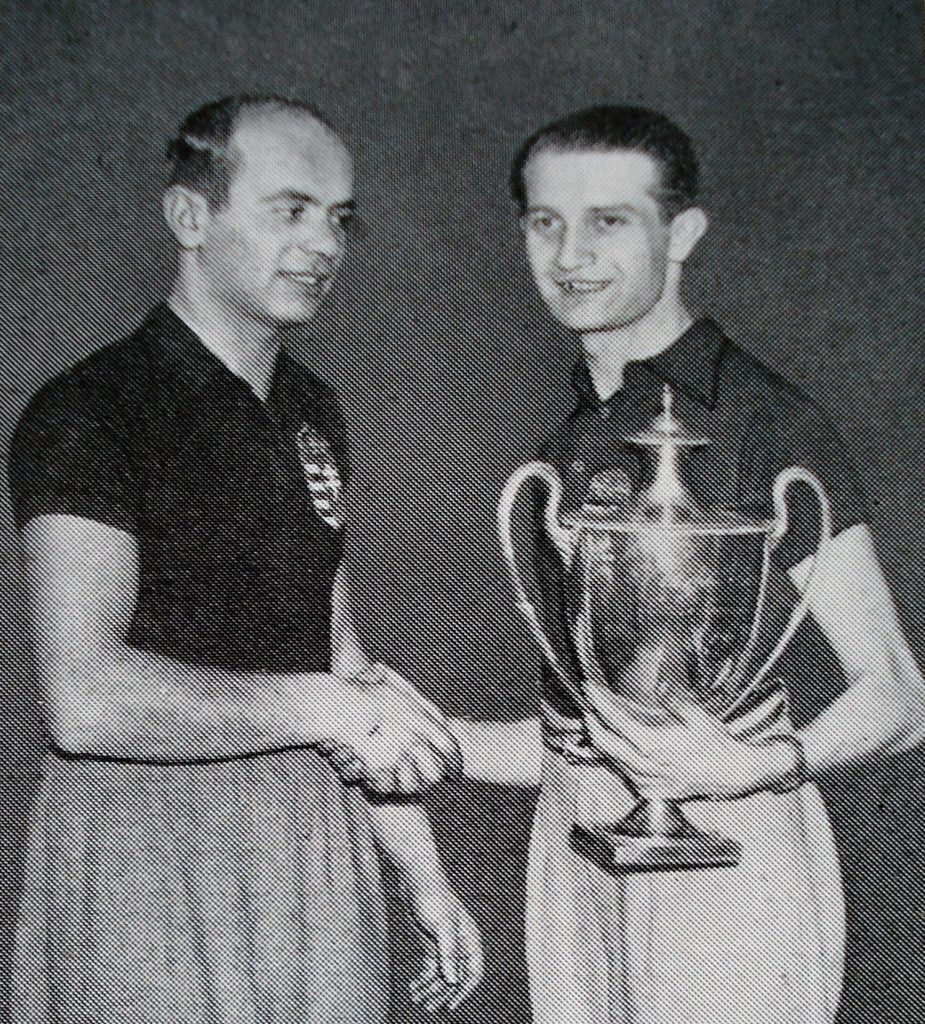
The Men’s Singles produced some lengthy matches. It was reported in the press that there was one rally between Michel Haguenauer, France, and Erwin Kohn, Austria, of 1,590 strokes. Another rally was just short of 1,000 strokes. The match lasted over two and a half hours and needed three umpires, the final score -18, -15, 13, 8, 10. Kohn went on to be a semi-finalist, losing to Miklos Szabados 13, 14, 18, who himself lost to Victor Barna in the final -17, 17, -19, 11, 19, his fifth title. Barna’s opponent in his semi-final was Alojzy ‘Alex’ Ehrlich, Poland, with the score -12, 11, 20, 15.
Bergl was England’s highest placed player reaching the quarter-finals were he lost to Kohn in another lengthy match 13, -10, -18, 19, 9. Hymie Lurie went out in the round of 16 to Laszlo Bellak, Hungary, and the round of 32 saw the departure of Herbert Hales, Haydon, Ken Hyde, Harold Shalson, Joe Silto, Herbert Bridge and W J Lean.
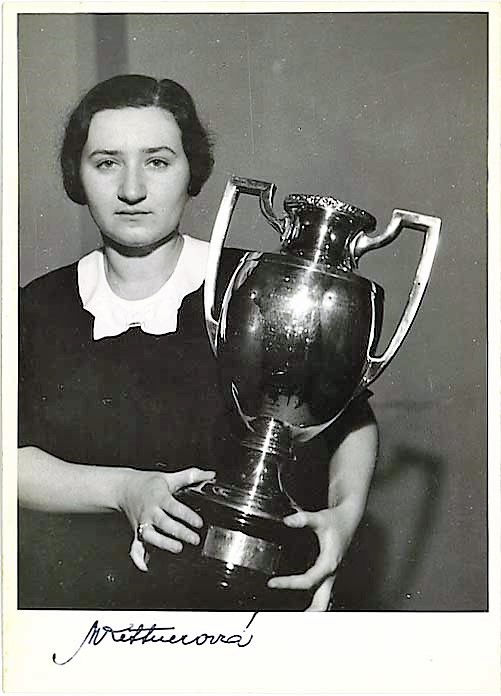
Maria Kettnerova, Czechoslovakia, retained her Women’s Singles title defeating Hungarian, Magda Gal, in the final -15, 18, 11,19. Losing semi-finalists were Marcelle Delacouer, France, and Marie Smidova, Czechoslovakia. Osborne and Connie Wheaton went out in the quarter-finals, Osborne to Kettnerova in a tight match 19, -14, -18, 16, 14. Wheaton’s loss was to Smidova 19, 17, 18. Nellie Wood, Valerie Bromfield, Dora Emdin and Miss L D Mine lost in the round of 16 whilst Joyce Bartholomew, Lilian Hutchings, Dinah Newey, Nora Norrish and Miss A Jackson were defeated in the round of 32.
The Men’s Doubles was another victory for Victor Barna, partnered by Szabados, 13, 16, 8. The partnership of England’s Haydon with Austria’s Alfred Liebster proved successful as they took the silver medal. They had come through five rounds to reach the final. France’s Raoul Bedoc & Daniel Guerin, and Bellak & Istvan Kelen of Hungary were the bronze medallists. The English pair of Shalson & Silto did remarkably well, although both international players they were not names that were so well known and they got as far as the quarter-finals. Jones & Tommy Sears, and A J Wilmott & Mr Milton went out in the round of 16.
Mednyanszky & Anna Sipos won the Women’s Doubles for the sixth consecutive time 11, -18, 11, 15 with their opponents in the final Kettnerova & Smidova. England’s Lena Booker, playing with Hilde Bussman, of Germany took the bronze, losing to Kettnerova & Smidova -17, 12, 11, 15. Two more Germans, Astrid Krebsbach & Anita Felguth, were the other bronze medallists. Quarter-finalists with English interest were Bromfield & Wheaton, Berry & Gertrude Kleinova (Czechoslovakia), who lost to the eventual champions, and Dora Emdin & Magda Gal (Hungary).
Haydon with Osborne gave Barna & Sipos a close game in the semi-finals of the Mixed Doubles, just losing 17, -19, -17, 19, 11. Szabados & Mednyanszky were the other bronze medallists. The final was fought between Barna & Sipos, and Stanislav Kolar & Kettnerova. It was the former who reclaimed the title they had last won in 1932 with the score 19, 13, -21, 11. Round of 16 placed players included Bellak & Berry, Alec Brook & Doris Emdin, Michel Haguenauer (France) & Lilian Hutchings, Ken Hyde & Nora Norrish and Tommy Sears & H R Evans (Wales).
So, for England it was one silver medal and two bronze, with Hungary and Czechoslovakia sharing the gold medals between them.
It was a huge financial commitment by the ETTA and the Championships left them with a shortfall of £511. Figures had been underestimated, based on previous entries it had been anticipated there would be a maximum of 12 teams not the 17 who attended. Hospitality had to be provided by the host nation for the officers of the ITTF and up to seven of each nation represented, two of whom had to be women.
Other major expenditure which had not been fully anticipated was at the Imperial Institute, where special floors had been built, tiered seating erected and the roof covered to exclude light, all of which came to £550.
There had been around 32,000 spectators in total and support had been strong throughout the country. LMS railway had put on 12 special trains from the Midlands and Lancashire for the sellout finals night. The ETTA share of ticket sales from the evening at Wembley was £600, even with that and income from the Imperial Institute it was not enough to cover all expenditure.
The loss had to be made good and so enthusiasts were asked to lend £10 to the ETTA with it being paid back with interest at 5%. Some took up this offer and a few donations were made to help. Nevertheless, the raising of the profile of table tennis by hosting the Championships was considered to have been worthwhile and beneficial. Membership numbers did increase, which would appear to justify the decision.
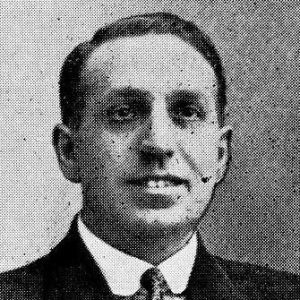
J Morris Rose (Referee): Born in South London circa 1899, Rose was one of the ETTA’s founder members and one of its most hard working. He was a member of the Provisional Committee and Assistant Honorary Secretary of the ETTA in 1926 and continued on its Executive Committee for many years.
Rose refereed three World Championships, 1935, 1938, 1948 and at least six English Opens from 1936 to 1949. In 1948 there was one match every two minutes for most of the 20 sessions. He travelled to World Championships in Cairo in 1939 where he was the Non-Playing Captain for the Swaythling Cup team.
He donated the J M Rose Bowl for the ladies National Team Championships and was a committee member for that competition from its inception until he died in 1952. The competition raised the profile, and the standard, of the women’s game. Before World War II he suggested the formation of a County Association which eventually came to fruition in 1946.
Rose served on the ITTF’s South Africa Committee as a would-be peacemaker, earning the respect and confidence of both rival organisations. Closer to home he was Hertfordshire County ETTA representative, President and Chairman of Surrey County, founder member, President and Chairman of the South London League, Secretary of Rovers TT Club and President and ETTA Representative of the Worthing League.
Not known so much for his playing ability, Rose did reach the semi-finals of the Civil Service Championships in 1939, no mean feat as its membership ran into the hundreds.
He was made an ETTA Vice-President in 1935, at that time the highest honour that could be awarded.
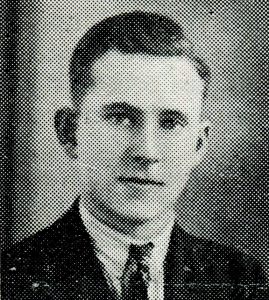
Maurice Bergl: Bergl was born in Mexico on 23 January 1917 and came to England in 1920. He played in four Swaythling Cup teams before World War II as well as in two Championships after the war. He twice reached the quarter-finals in individual events – Men’s Singles in 1935 and Mixed Doubles in 1937 with Lilian Hutchings. In the Swaythling Cup the teams finished fifth twice, seventh and eighth. His highest England ranking was number three.
Bergl gained 10 other international caps with matches against Hungary x 2, India x 1, Ireland x 1, USA x 1, Wales x 5. He was England captain in his last match against Wales in 1939. At the English Open in 1933/34 he won the Junior Boys Singles title, was runner-up in the Men’s Single and semi-finalist with Bert Hales in the Men’s Doubles, a considerable achievement for a teenager.
At Open tournaments, Bergl won over 20 titles including an impressive five consecutive Middlesex Opens from 1933/34-1937/38. He also won the Middlesex County Closed, London TTL Closed and Wembley TTL Closed.
Originally a member of the famous Herga Club which produced so many excellent table tennis and tennis players, Bergl benefitted from being a member as he not only became an England table tennis international but was junior lawn tennis champion of Middlesex.
In 1934, with Ken Hyde, Bergl went on a tour of Europe and played in Hamburg, Kiel, Stettin, Berlin, Halle, Magdeburg, Dresden and Amsterdam. He took part in a number of exhibitions being a member of the ‘All England Exhibition Circus’, he also played in a number of exhibition matches against the Hungarians when they visited England in the 1930s.
In 1937 Bergl was described “… for sheer brain and the ability to adapt his game to his opponent’s disadvantage, he stands head and shoulders above any English player we choose to call first-class”.
Harold Shalson: From London, date unknown. Shalson earnt one international cap, against Wales in the 1934/35 season. 1935 was the only World Championships he played in , partnering Joe Silto the pair reached the quarter-finals in the Men’s Doubles. His best result in any competition was probably getting into the semi-finals of the English Open in 1936 with Bert Hales. Playing in the London League for the Hillside Club, he won the League’s Men’s Singles in 1933/34.
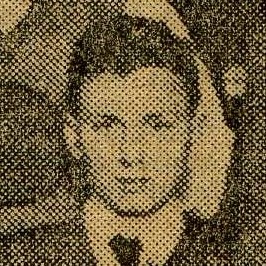
Joe Silto: Friendly and popular Silto was the first player from Wiltshire to play for England. He was born in Swindon on 31 May 1911. His first international match was against Wales on 7 February 1931 and he gained a further cap when he was playing captain against the Irish Free State in Dublin on 18 January 1936. In the World Championships in 1935 he narrowly lost his singles match in the round of 32 against seeded top Czechoslovakian player, Bohumil Vana, and then had that excellent result reaching the quarter-finals in the Men’s Doubles with Harold Shalson.
Silto won a few Open tournaments as well as five singles and five Men’s Doubles titles in the Swindon League before World War II interrupted his play. He joined the army at the outbreak of war and fought in North Africa and Europe, landing in Normandy a couple of days after D-Day. He had a lucky escape when he was in Antwerp as the building he was in was hit by a German V2 rocket.
Silto carried on playing after the war and into his 50s, as might be expected in Swindon, he played for the Railway Athletic Association and won six titles in their championships. He was chairman of Swindon League for a number of years.
His other sport was football and he was no mean player, playing for Swindon reserves.
Later in life, he wrote two books about the home town he loved ‘A Swindon History’ and ‘The Railway Town’.
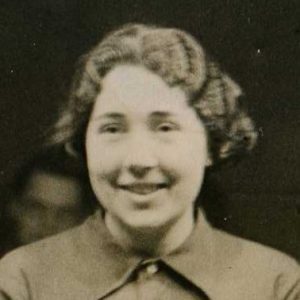
Marjorie Berry: Another English international from St Albans, date of birth unknown. Berry played against Wales on four occasions with her debut on 9 April 1932. She played in one World Championships, London 1935, with a round of 64 defeat in the Women’s Singles to fellow England international Valerie Bromfield. Playing with Gertrude Kleinova in the Women’s Doubles they had the unfortunate draw in the quarter-finals to meet the eventual champions, Maria Mednyanszky and Anna Sipos. The round of 16 saw another difficult draw in the Mixed Doubles, playing with Laszlo Bellak the pair met Miklos Szabados and Maria Mednyanszky.
Ranked four in England, Berry won several Open tournaments in the south of England as well as Closed tournaments in the Civil Service, London and St Albans Leagues.
Berry was chairman of the BBC TT Club before the war.
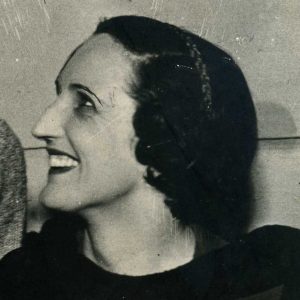
Mrs Lena Booker: Born as Miss Henocq in Pimlico, London on 25 November 1909, she married Arthur Booker on 10 March 1934. A medallist at the World Championships in 1935 when playing with Hilde Bussman, Germany, the pair were losing semi-finalists to Maria Kettnerova and Marie Smidova -17, 12, 11, 15. Booker lost in the round of 64 in the Women’s Singles to semi-finalist Smidova and the same round in the Mixed Doubles with David Jones.
Booker played in three international matches against Wales, and one against the USA in 1936/37. She won several Open tournaments, mainly in the south of England but had impressive results at the Merseyside Open when she won all three titles in 1937/38, playing with Lilian Hutchings in the Women’s Doubles and Victor Barna in the Mixed Doubles. She also won the Wembley Closed in 1933/34.
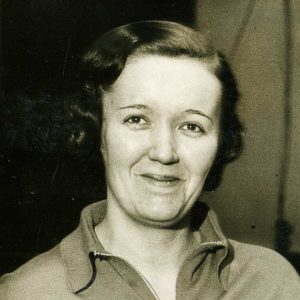
Valerie Bromfield: A member of the famous St Bride’s Club and daughter of Percy Bromfield. Percy was one of the founders of the ETTA as well as being Chairman of the Ping Pong Association in 1921-22 and the Table Tennis Association in 1922-23 and 1925-26. With such a family history it was understandable that Valerie who was born in Muswell Hill, London on 26 March 1912 would be involved in the game.
Before 1935 she had already played in the first World Championships with her father in 1926 reaching the quarter-finals in the Mixed Doubles. In 1935 she had made it into the Corbillon Cup team which finished fourth, playing in seven matches. In the Women’s Singles she lost to Gertrude Kleinova in the round of 16, in the Women’s Doubles she was a quarter-finalist with Connie Wheaton and got as far as the round of 32 in the Mixed Doubles with Loewenhertz from Poland.
Valerie’s first international cap was against Wales in 1930/31, she played against them again in 1932 and 1934.
A top English player whose highest world ranking was three which reflected some of her results, particularly in the English Open, where she won the Women’s Singles in 1931 and was a semi-finalist in 1932 and 1936. The same year, with Sandor Glancz, Hungary, she won the Mixed Doubles. Added to which were a considerable number of Open titles and Closed titles at the Civil Service Championships and in the London League.
Mrs Mary Holt: Of West Ealing. Holt only played in the Women’s Singles in the 1935 World Championships where she lost in the round of 64 to fellow England international Lilian Hutchings.
An international who was playing captain against Wales in 1931, 1932 and 1933 and also played against them in 1935/36. At the English Open in 1930/31 Holt was a semi-finalist in the Women’s Singles and won the Women’s Doubles with Nellie Wood.
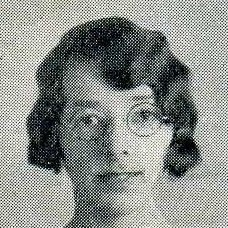
Phyllis Moser: Playing in the one World Championships in London as an individual entrant, Moser was nevertheless a good player who played in the first women’s international match against Wales in 1930. She also played against them in 1932 and 1934 and against the Irish Free State in 1929/30 and 1932/33. She was ranked six in England and eight in the world.
Born on 11 April 1902 in Lamberth, London, Moser married fellow international, Richard ‘Dickie’ Dawson in 1945, she played for the St Bride Club in the London Business Houses ASA (TT Section) and was the Bridelians Secretary.
In the English Open she won the Women’s Doubles with Czechoslovakian, Marie Smidova, in 1928/29 and Dora Emdin in 1934. A runner-up in the Women’s Singles in 1928/29 and a semi-finalist in 1934. In the Mixed Doubles, playing with her husband, she was a semi-finalist in 1930 and a quarter-finalist in 1932. Another player who played in a number of Open tournaments with several wins, Moser also won the London League Women’s Singles in 1929/30.
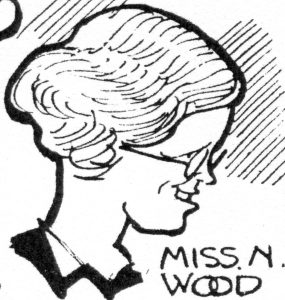
Nellie Wood: From St Albans, Hertfordshire born on 17 November 1904, Wood played in the one World Championships in 1935. A four times international against Wales, her first in 1930/31, Wood had an impressive record in the English Open. She reached the semi-final of the Women’s Singles in 1933, was twice winner in the Women’s Doubles, the first in 1931 with Mary Holt and the second in 1933 with Wendy Woodhead. 1928 and 1932 saw two runners-up positions with Doris Emdin and Mary Holt respectively and she was a semi-finalist in 1934 with Doris Emdin. In the Mixed Doubles she gained another bronze medal in 1928.
Wood won a number of Open tournaments in England from the late 1920s until the outbreak of war. She continued playing afterwards locally, winning the St Albans Closed Women’s Doubles five times, the last with Doris Emdin in 1949/50. Her highest England ranking was eight.
Wood was another lady from St Albans who was involved with administration. She was on the ETTA Executive (Emergency) Committee for St Albans and a co-opted Member in 1934-35. She was also on the ETTA Women’s Committee and Honorary Secretary for the Southern Section.
Latest news
- Uncategorised
- U10-U13 Nationals
- From the Archives
Heading down Wembley Way for the first time - the 1935 Worlds