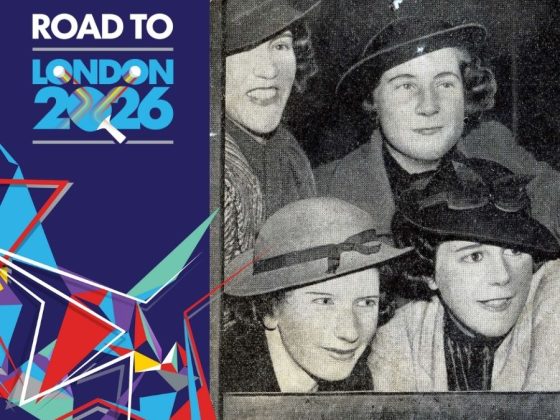
In the latest instalment of our series on England’s World Championships performances over the years, Diane Webb (Chair of Archives, Museum and Records Committee) shines a light on 1936 – a Championships mired by controversy. With thanks to Gunther Angenendt for photos.
Keep an eye on our website and social media platforms for a host of features in our Road to London 2026 series – and click below to secure your tickets for London 2026.
It wasn’t an auspicious start to the 10th anniversary of the World Championships when “the International Table Tennis Federation announces that arrangements to hold this year’s Congress in Zagreb have been cancelled. This is an unprecedented happening all the more unfortunate as the Jugo-Slavian TTA had given a definite undertaking. There had been hopes of securing Royal Patronage”.
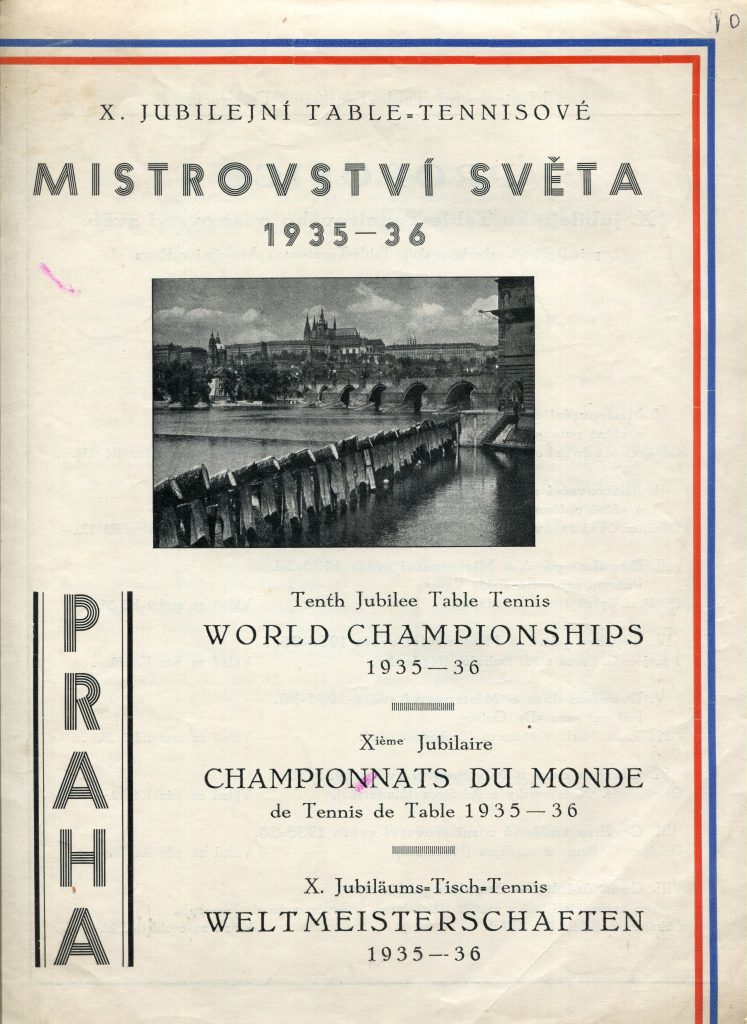
Other nations were asked to consider hosting and there were serious concerns that there would be no Championships. However, Prague came to the rescue and on 12th March 1936 the Championships started. Play was from 9am-noon, 2pm-6pm and 8pm-midnight daily – although as will be seen it didn’t quite work out like that.
International Eric Findon wrote a witty piece, wishing the team well and hoping conditions were better than the last time England played in Prague four years ago. He said the hospitality of the Czechs was unbounded, the crowd were a sporty lot who liked good play and showed their appreciation but the tables “looked rather like the English Channel during a heavy ground swell”. The food wasn’t always to their liking with duck seeming to appear on every menu, the bread was covered in seeds and one of the players asked if the English team was taken for a flock of canaries.
Swaythling Cup
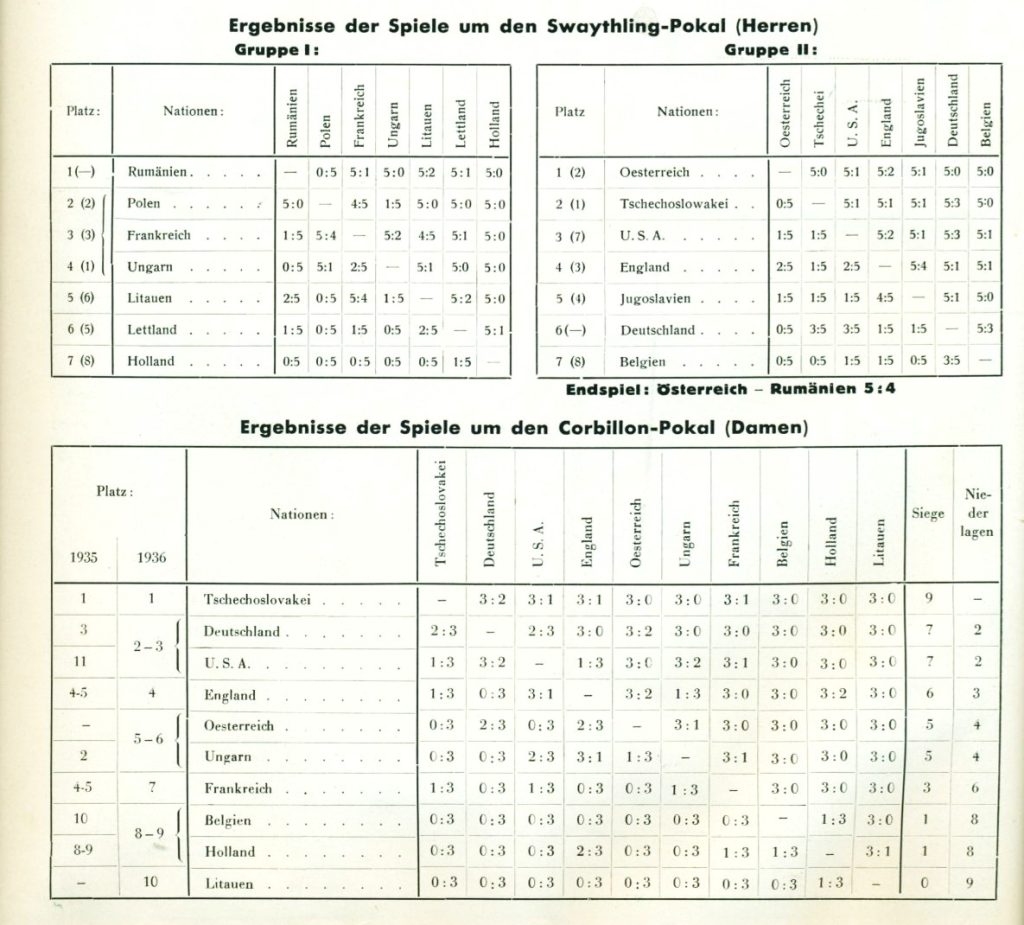
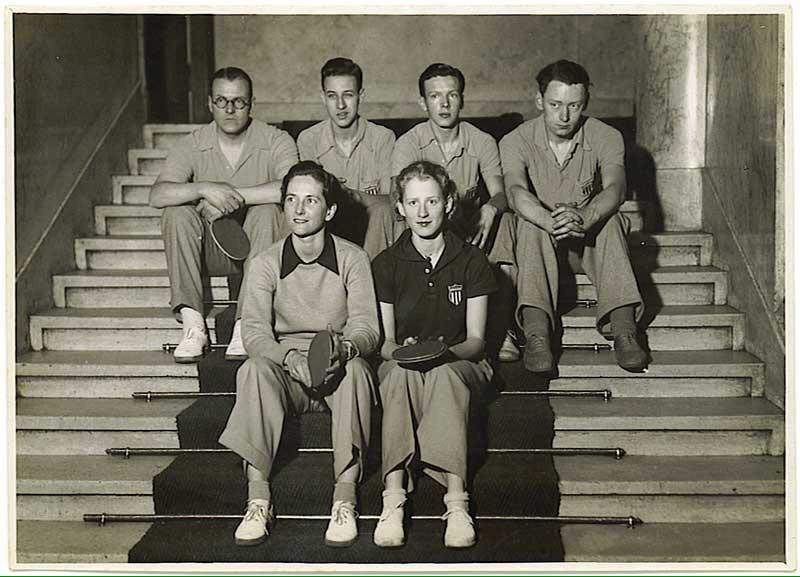
There were 14 entries in the Men’s Team event split into two groups. The top two teams in each group went on to battle it out for the title. England had Austria, Belgium, Czechoslovakia, Germany, USA and Yugoslavia in their group. Their squad of five had all played in World Championships before and four of them in the Swaythling Cup.
Maurice Bergl and Adrian Haydon had played in the Swaythling Cup matches in London last year, Ken Hyde in Paris in December 1933 and Stanley Proffitt in 1931. Hymie Lurie was the newcomer having proved himself at last year’s World Championships in the individual events. The cost to the ETTA of sending the teams was £102 7s 6d.
England sent an attacking team to Prague which finished with three wins and three losses in their group. It was success against Belgium 5-1, Germany 5-2 and Yugoslavia 5-4. However, losses against Austria 5-2, Czechoslovakia 5-1 and the USA 5-2 resulted in a final placing of fourth in the group and eighth overall.
Haydon was the outstanding player for the England team losing just one of his nine matches, to ‘Buddy’ Blattner of the USA. Haydon’s most impressive results were against eventual champions, Austria. He beat Helmut Goebel 17, -10, 18 before taking on the young 16-year-old prodigy, Richard Bergmann, against whom he had a -17, 17, 12 win. It was the only match Bergmann lost in his 11 Swaythling Cup matches. Hyde won five and lost four matches, Bergl won three and lost six whilst Lurie and Proffitt both won two and lost five.
In the other group there were some surprises as holders Hungary lost to Romania (spelled Roumania in those days) 5-0 and then with their strongest team of Barna, Bellak and Szabados lost to France 5-2. They finished with four wins alongside Poland and France. Lithuania, Latvia and Holland made up the other teams.
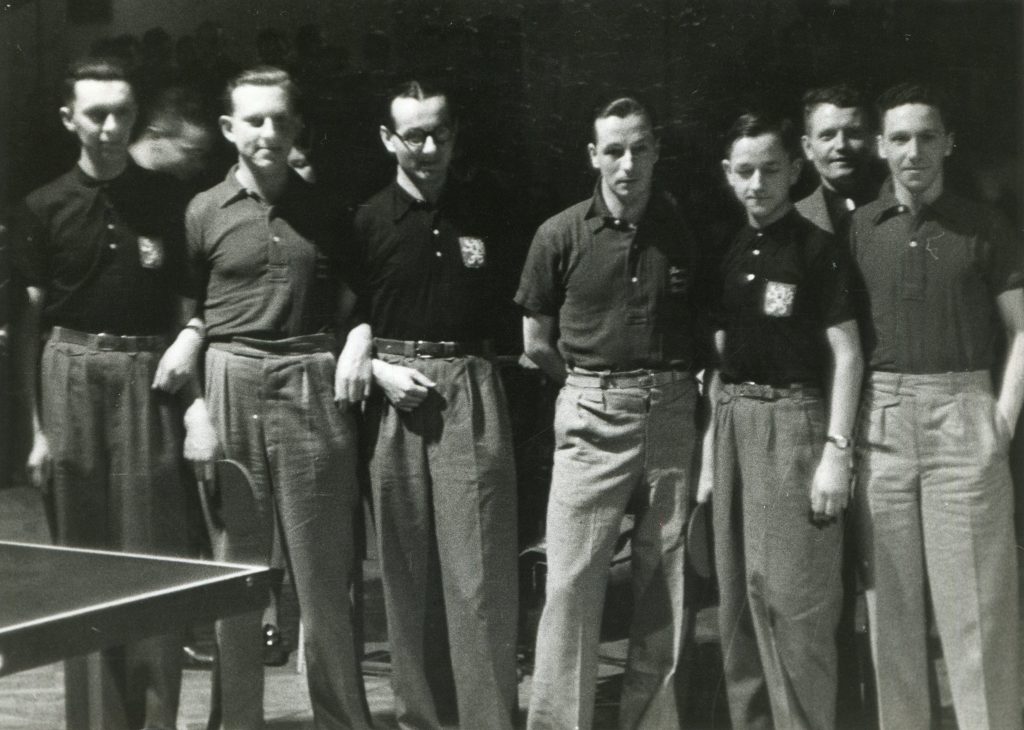
Courtesy of Gunther Angenendt
The Longest Point
The match between Romania and Poland resulted in what is regarded as the longest point. Poland’s world No 2, Alojzy ‘Alex’ Ehrlich and Romanian, Farkas Paneth were the players. Paneth won the toss at which point Ehrlich changed the bat he had been knocking up with for his much larger ‘chiselling’ bat. Paneth was a renowned ‘chiseller’ and Ehrlich was determined to meet like with like and not to hit a ball, thus wearing down his opponent so that he would be too tired to win either of his other two matches.
Play started and the ball went back and forth over the net, always to Paneth’s forehand. After 70 minutes the weight of Ehrlich’s extra large bat was having an effect, so he changed to playing with his left hand and then later still back to his right. Some Austrian players interested in the result as this would decide their opposition in the final, had gone to see a film came back to see the score 0-0. They thought the scoreboard must be broken, but no, the first point was still being played.
To help relieve the boredom, Ehrlich had a chess board set up by his side of the court and calling out his moves conducted the chess match whilst still playing that first point.
The ITTF decided something must be done so over loudspeakers they called all delegates to a meeting. There was one problem – Ehrlich was the Polish delegate. So, the delegates moved to the courtside and held the meeting there.
The first proposal to the two players was to call the match a draw, they both responded with a firm ‘no’. The it was suggested they play five more minutes and although Paneth was in favour, Ehrlich wasn’t, he felt the longer the match lasted the more it was in his and his team’s favour. They continued playing.
Then Ehrlich decided he was hungry and from his bag took out a knife, a loaf of bread and a two-foot Polish sausage and began to make a sandwich accompanied by a Thermos flask of coffee. And now, after two hours and 12 minutes and over 12,000 hits, Ehrlich at last played to Paneth’s backhand, every shot up to this point had been on his forehand, the backhand shot was missed. The first point had been won.
Paneth quickly won the second point with an unexpected hit. The rest of the game lasted 20 minutes. The final score 18, 8 to Ehrlich, who declared his tactics had won the match. Paneth, on the other hand, claimed that he had been told by his captain that the results of the other matches which by this time had all finished, meant irrespective of the result of the Romania/Poland match that Romania would be in the final. The pressure was off to win. So, the match score showed Poland won 5-0 but it was Romania who were in the final. There were 3,500 spectators at the beginning of the match, a very small handful by the end.
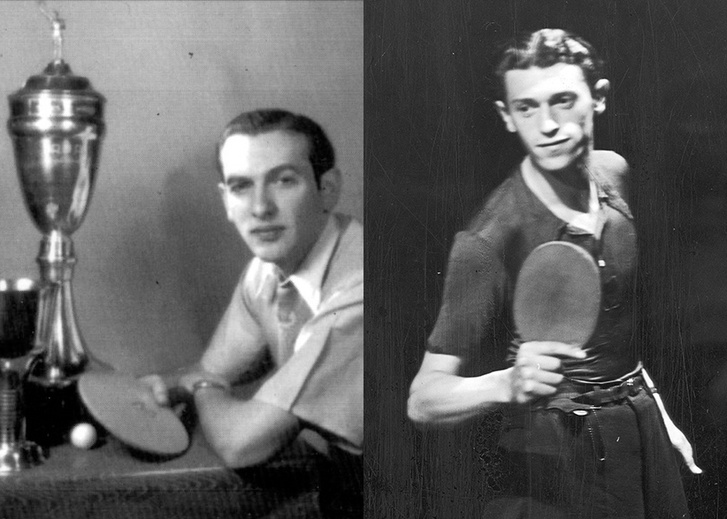
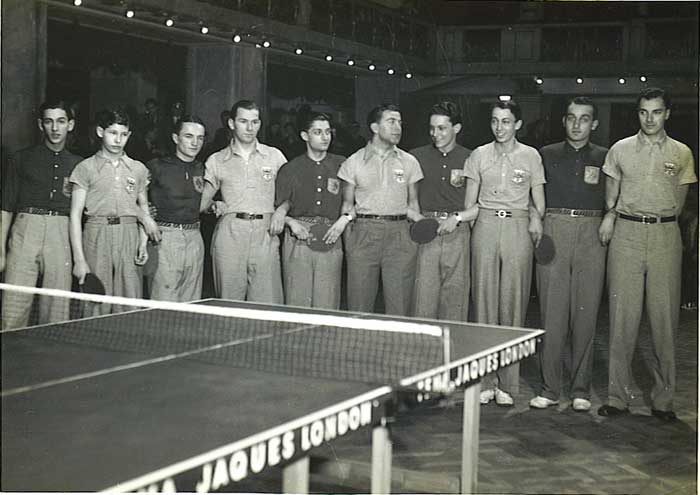
The final was between Romania, top of Group 1 and Austria, top of Group 2. Austria’s team of Bergmann, Helmut Goebel and Alfred Liebster took on the Romanians, Vasile-Goldberger Marin, Farkas Paneth and Viktor Vladone. Play commenced on Sunday, 15 March at 9.30pm. By 3.30am the score was two games all and the match was postponed until later in the week.
With the score at 4-4, the last match was Paneth versus Liebster. Although Paneth had a good lead in the final game it was Liebster who was victorious 15, -8, 10, to win the Swaythling Cup for Austria after 11 hours play. Bergmann had three wins and with one apiece for Liebster and Goebel against Vladone.
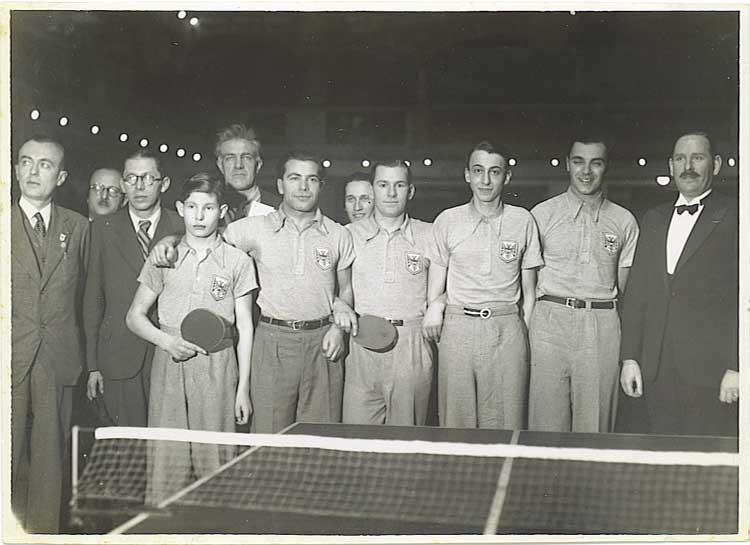
Courtesy of Gunther Angenendt
Corbillon Cup
The Women’s Team event was played as a round-robin of 10. Margaret Osborne and Wendy Woodhead were emerging as England’s strongest players and they played the lion’s share of the matches, with Lilian Hutchings and Dinah Newey as support.
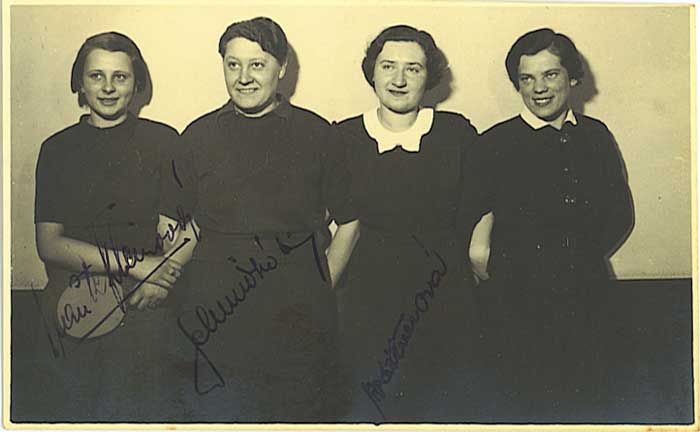
England won five of their matches with victories over Belgium, France and Lithuania, all 3-0. Against the USA, joint silver medallist, it was a 3-1 win for England with Osborne losing the one match against Ruth Aarons 14, -13, 10. England lost to Hungary 3-1 with Woodhead getting the sole result against Maria Mednyanszky, the former world champion. It was also a 3-1 loss against Czechoslovakia with Osborne again playing superbly to defeat reigning world champion Maria Kettnerova 16, 15. Against Germany it was a 3-0 loss and the same score against Austria.
Czechoslovakia became the new holders of the Corbillon Cup, Germany and the USA shared the silver medal position. England finished fifth equal with Hungary.
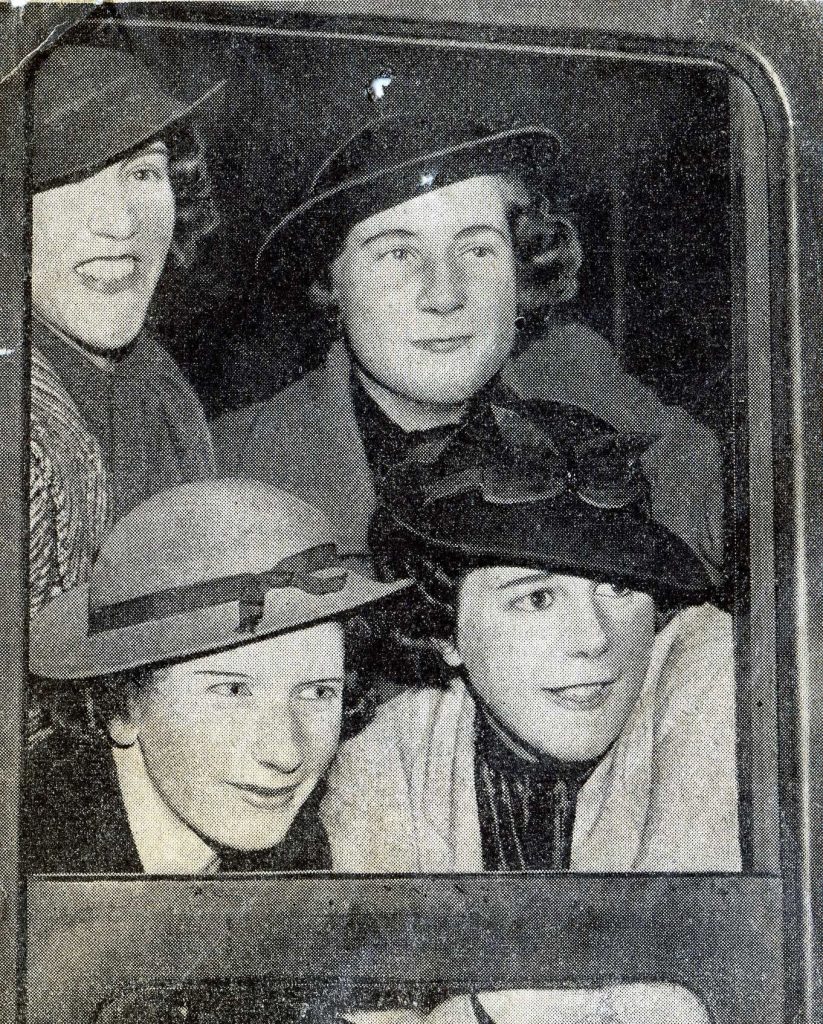
Woodhead won five of her matches and lost three, Osborne won five and lost seven, Newey won one with no losses and Hutchings won one and lost one. In the doubles, the partnership of Osborne & Woodhead resulted in winning four and losing four and Newey & Woodhead won their sole match.
Men’s Singles
There were certainly some unexpected results in the Men’s Singles. The biggest shock was five times champion, Victor Barna, losing to compatriot Ferenc Soos in the round of 32 in three games 15, 19, 11. Soos reached the semi-finals where he lost to 18, -18, 18, 18 to Stanislav Kolar, Czechoslovakia, who went on to become the new champion.
The other semi-final was between Poland’s Aloizy ’Alex’ Ehrlich and Richard Bergmann and that match went to Ehrlich -16, 16, 18, 10. The final was a tight five-game match with Kolar winning -18, 14, -16, 12, 19.
Haydon, once again, was the best England player, going out in the quarter-finals where he lost to Bergmann. Hyde and Proffitt both reached the round of 16. Tommy Sears who had travelled as an independent entry went out in round of 32, Bergl, along with Fred Cromwell, A J Wilmott and Mr Piggins exited in the round of 64 and Maurice Goldstein, Lurie and Mr McNutt departed in the round of 128.
The Longest Match
You may recall that Michel Haguenauer of France had a lengthy match in London lasting two-and-a-half hours. That was short in comparison to his match this year in the round of 16 against Marin. After eight hours and with the score standing at 11, -16, 4, -5 and 5-5 in the fifth game the players were given 20 minutes to finish the game or both would be scratched. Only two points were played in those 20 minutes and the two players decided to toss a coin to decide the winner of the match. Marin won and went through into the next round.
Women’s Singles
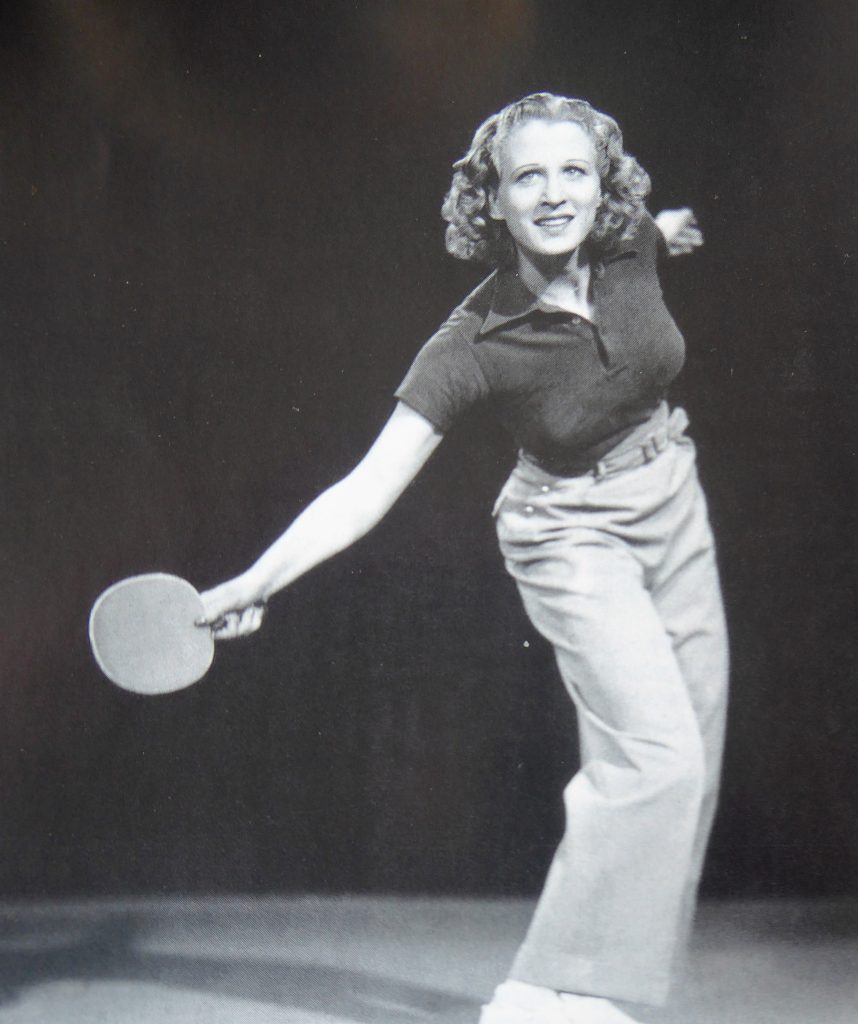
The Women’s Singles also saw some new names and it was the young American, Ruth Aarons, who held the trophy aloft after beating Astrid Krebsbach, Germany in the final 16, 14, 11. Aarons had earlier despatched Marie Kettnerova in the semi-finals but not before several spectators had asked for their money back when the game was at 1-1, it eventually finished -16, 19, 18, 18 in Aarons’ favour. Czechoslovakia, Marie Smidova won the other bronze medal.
Osborne lost to Kettnerova in the quarter-finals 19, 15, 15 whilst Hutchings and Woodhead both went out in the round of 16 and Newey in the round of 32. The only other female English player was Mrs McNutt who lost her first match in the round of 64.
Men’s Doubles
It was a second gold medal for the USA in the Men’s Doubles as Robert ‘Buddy’ Blattner & Jimmy McClure beat Czechoslovakians Kolar & Okter Petrisek 11, 7, 9 in the final. They just made it through to the final after a win against Czechoslovakians, Karel Fleischner & Adolf Slar in the semi-final after being down 13-21, 21-23, 21-11, 11-19, eventually winning the last two games 23-21, 21-18. The other bronze medal went to Hungary’s Tibor Hazi & Soos.
Fleischner & Slar had beaten the strong combination of Haydon & Liebster in the first round 8, 10, 19. Also going out at that stage were Cromwell & Lurie and Piggins & McNutt. Going one better were Wilmott & Goldstein and Hyde & Sears. Bergl & Proffitt made it as far as the round of 16 before losing to Hazi & Soos.
Women’s Doubles
Last year’s silver medallists went one better this year as Kettnerova & Smidova took the title in the Women’s Doubles with a 14, 18, -13, 14 victory over fellow Czechoslovakians Vera Votrubcova & Vlasta Depetrisova. Aarons & Jessie Purves, and Magda Gal & Mednyanszky, were bronze medallists.
England’s quartet had the misfortune to meet both finalists in their first matches, Hutchings & Newey losing to the Czechoslovakians and Osborne & Woodhead to the Americans -20, 17, 16, 17.
Mixed Doubles
There wasn’t much to cheer about for England in the Mixed Doubles. The round of 16 was the best for any pair. Haydon & Osborne, Hyde & Newey and Lurie & Woodhead all went out although the latter partnership did lose to the eventual champions. All others lost in either the round of 64 or the round of 32.
At 2.30 in the morning, the two Czechoslovakian pairs, Miloslav Hamr & Gertrude Kleinova and Stanislav Kolar & Marie Smidova were due to play their semi-final. The winners would meet Hungary’s Istvan Kelen & Maria Mednyanszky in the final. Both Czech pairs refused to play, perhaps understandably. It would have been particularly onerous for Kolar who had played in the Men’s Singles and Men’s Doubles finals earlier.
The rules stated that if a player/team scratched their opponent/s have to be declared the winner. If this rule was applied it would mean the title would go to Hungary. ‘The Committee’ met and allowed the match to be played at a later time. Kelen & Mednyanszky after staying up half the night to play had to trudge back to their hotel in the early hours. When the match was played it was the home pair of Hamr & Kleinova who won with a 3-1 win over Kelen & Mednyanszky. This wasn’t the only decision where rules were waived in favour of home players.
ITTF Congress and Concerns
There was one major change to the rules at the ITTF Congress which was for finger spin services to be abolished for an experimental period of one year. To help encourage more attacking play England proposed that every country trial two tournaments with the net at 6” instead of the current 63/4 and report back to the next Congress.
The ETTA Executive Committee report at their AGM said “The World Championships in Prague were carried out under wholly unsatisfactory conditions, which we must all deplore. To what extent this was due to thoroughly inadequate organisation, and to the amazing outbreak of “pushing,” the new danger now threatening the game, is not clear. In any case, we can only say, we hope the circumstances will never be repeated”.
This wasn’t the only criticism, Tommy Sears wrote: “The tables we played on were so soft that one could press one’s fingers in them – except for one Jacques table top which was almost entirely reserved for Czech players. There were many unfortunate incidents; a great many of them due to rank bad decisions by umpires – invariably in Czech players favour.”
How to resolve these issues? Ivor Montagu, ITTF President, reported later in the year that there had been discussion to restrict the World Championships to the two team championships – the Swaythling Cup and Corbillon Cup and by April 1936 an interim regulation had been drawn up setting a time limit for games.
NB: Various sources report different results and information so it has not always been possible to establish which information is correct.

Fred Cromwell: Frederick ‘Fred’, ‘Ollie’ Cromwell played in one World Championships in 1936 and although not part of the Swaythling Cup team was selected as part of the England team to play in the Men’s Doubles with fellow Mancunian, Hymie Lurie. Born in Manchester on 25 December 1909, Cromwell gained his first international cap against the Irish Free State on 3 March 1934, he captained the winning team, he played one further international, against Wales on 11 January 1936 and it was another win for England. A regular on the Open circuit in England in the mid/late 1930s with several titles, he also won the Manchester Men’s Singles Closed in 1932/33 and two Men’s Doubles titles, this was a time when Manchester had several international players. A member of the Manchester League team which won the first Wilmott Cup (National Men’s Team Championships) in 1935. Cromwell played in several inter league matches, Hungarian tours in 1935 and 1936 and a number of exhibition matches. He also played for Lancashire in county matches. For the Manchester & DTTL he was an ETTA representative and was an ETTA Approved Local Coach in 1950/51.
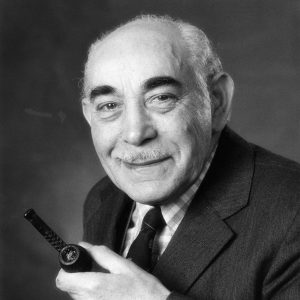
Maurice Goldstein: Goldstein played in three World Championships, 1936, 1938 and in the Jubilee Cup in 1959. It is reputed that he umpired the longest point in Prague, at least for part of it. However, it was not as a player that Goldstein was known. His influence in Warwickshire and the Birmingham area was legendary. Born in Birmingham on 28 February 1911, his whole life revolved around table tennis. He received many honours and accolades. ETTA President from 1973-1988, an Honorary Life Member in 1957 and recipient of the Leslie Forrest Memorial Trophy in 1969. Heavily involved with the World Championships in Birmingham, his home town, he was made an MBE in 1978. For the ETTA, Goldstein was a member of the National Executive Committee for a number of years, served on over 20 other committees. His knowledge led to him being a member of the ITTF Equipment Committee from 1954-1956.
Goldstein was also involved at a more local level and was an officer of the Warwickshire County Committee, Birmingham & DTTA, Midland League, Midland Schools TTA, Tamworth TTL, Dunlop Sports TTC, Jewish Cadets, Birmingham Open, Midland Open, Midland Counties Open, West Midlands Junior 2*Open. He became a County Umpire in 1951 and a Tournament Referee in 1971.
Mrs Lilian ‘Twinks’ Hutchings: Of St Albans, date of birth unknown. Hutchings played in four consecutive World Championships from 1935 with the one Corbillon Cup appearance in 1935 when the team finished fifth. 1937 was a good year for Hutchings where she won a bronze medal with Stefanie Werle, Austria, in the Women’s Doubles and two quarter-final places in the Women’s Singles and Mixed Doubles with Maurice Bergl.
Hutchings won four other international caps, two against Wales, one against the Irish Free State and one against the USA. At the English Open in 1935/36 she was runner-up in the Women’s Doubles with Mrs D Law. Another prominent player on the Open circuit with wins at Bournemouth, Hampshire, Kent, Merseyside, Midland, North of England, North London, Surrey, West of England and West London.
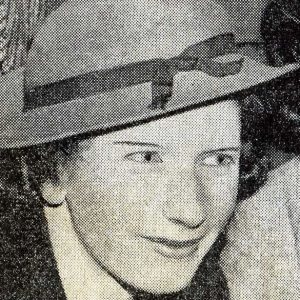
Dinah Newey: Born 18 March 1914 in Kings Norton, Warwickshire, Newey played in the World Championships in 1935 and 1936, being part of the Corbillon Cup team in 1936 in Prague. She played in ten internationals – against Hungary, the Irish Free State and Wales. At the English Open in 1933/34 Newey was runner-up in the Women’s Doubles with Maragret Osborne, and a semi-finalist in 1933 with Marjorie Berry. She played in a considerable number of Open tournaments both before and after World War II winning over 30 titles. She represented Warwickshire and in the Birmingham Closed won Women’s Singles and Women’s Doubles titles. Her highest England ranking was five.
Her father, W F Newey, was Chairman of the Birmingham & DTTA and her mother Chairman of the ETTA Women’s Committee (Northern Section) and Secretary of the King’s Heath TTC. In 1939 Newey Married Gilbert Smith and later moved to Oregon, USA.
Latest news